
Charm, vanna and the 0DTE clock
How time and implied volatility change option delta on same-day expiries, and where the hedge story stops.
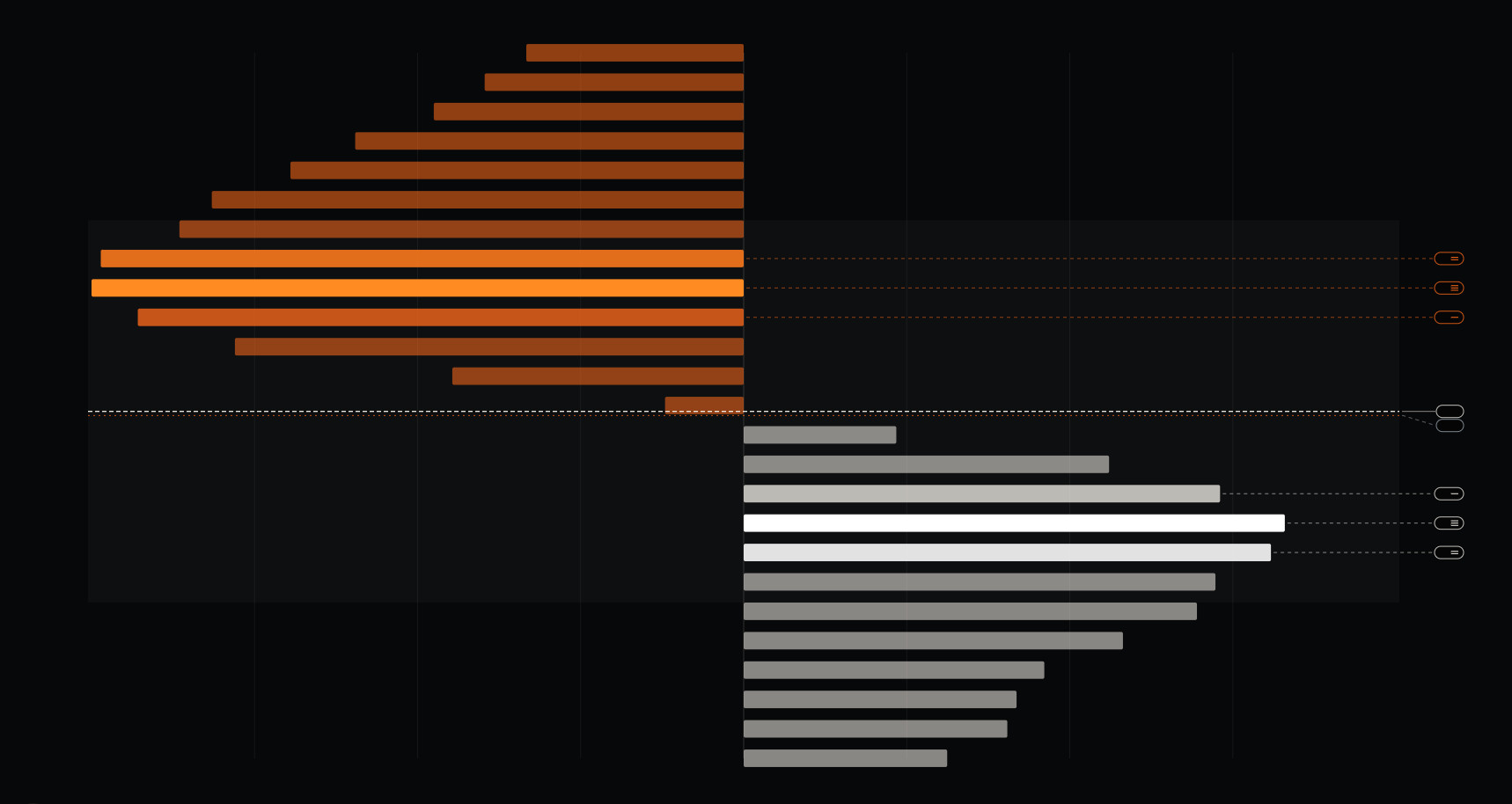
An option's delta can change while the underlying sits still. Time passes, and implied volatility changes. Traders call the sensitivity of delta to time charm and the sensitivity of delta to implied volatility vanna. On a short-dated option, both can matter within one session. Neither gives a reliable directional forecast by itself.
Charm: the clock changes delta
Consider an out-of-the-money call that expires this afternoon. With the underlying below its strike, less time to expiry usually pulls its delta toward zero. An in-the-money call's delta tends toward one as expiry approaches. The corresponding put deltas move toward their own expiry outcomes. A participant hedging those options may need to adjust even if spot has barely moved.
The hedge direction depends on the actual position. You cannot infer a market-wide afternoon buy program from the word charm. You need to know who owns which side, the expiry distribution, and what has already been hedged. A large calculated charm exposure is a sensitivity estimate, not a record of orders that must hit the market at a fixed time.
Vanna: volatility changes delta
Vanna describes how delta changes when implied volatility changes. Ahead of an event, option prices may carry extra premium for uncertainty. After the event, implied volatility can fall as uncertainty resolves. That repricing can alter deltas and the hedges tied to them even if the underlying returns to its starting price.
The direction of any resulting underlying flow depends on the option type, moneyness, position sign, and how participants hedge. Short summaries such as “vol down means spot up” skip those conditions. The useful question is which contracts dominate the book and how their deltas would change under a plausible volatility move.
What 0DTE makes different
A 0DTE contract expires today. Near the money, its delta can change sharply with a small price move, while each passing hour alters the time left for that move. This is why a same-day profile may look different at 10 a.m. and 3 p.m. even when official open interest has not updated. The Greeks have changed; the underlying and implied volatility may have changed too.
Cboe's published work on SPX 0DTE also cautions against translating large gross volume directly into large market-maker hedges. Customer buying and selling can offset. Net risk, which the public chain does not show directly, determines the hedge that might be needed.
A careful way to use the clock
First check the contract's expiry and settlement terms. Then look at how near spot is to heavy same-day strikes, whether implied volatility is repricing, and whether a scheduled event is approaching. Recalculate rather than carrying a morning sensitivity into the close. If your idea depends on a particular charm or vanna flow, write down the position assumption that gives the flow its direction.
Sources and further reading
The research this guide leans on. Citations rather than links, so they stay verifiable after journal URLs move.
- Taleb, N.N. (1997). Dynamic Hedging: Managing Vanilla and Exotic Options. Wiley.
- Hull, J.C. Options, Futures, and Other Derivatives. Pearson, chapters on higher-order sensitivities.
- Beckmeyer, H., Branger, N. and Gayda, L. (2023). Retail Traders Love 0DTE Options. Working paper.
- Ni, S.X., Pearson, N.D., Poteshman, A.M. and White, J. (2021). Does Option Trading Have a Pervasive Impact on Underlying Stock Prices? Review of Financial Studies 34(4).
- Cboe Global Markets (2025). 0DTEs Decoded: Positioning, Trends, and Market Impact.