
The expected move and event premium
Read a straddle around a scheduled event, including premium, expiry and the possible volatility decline afterward.
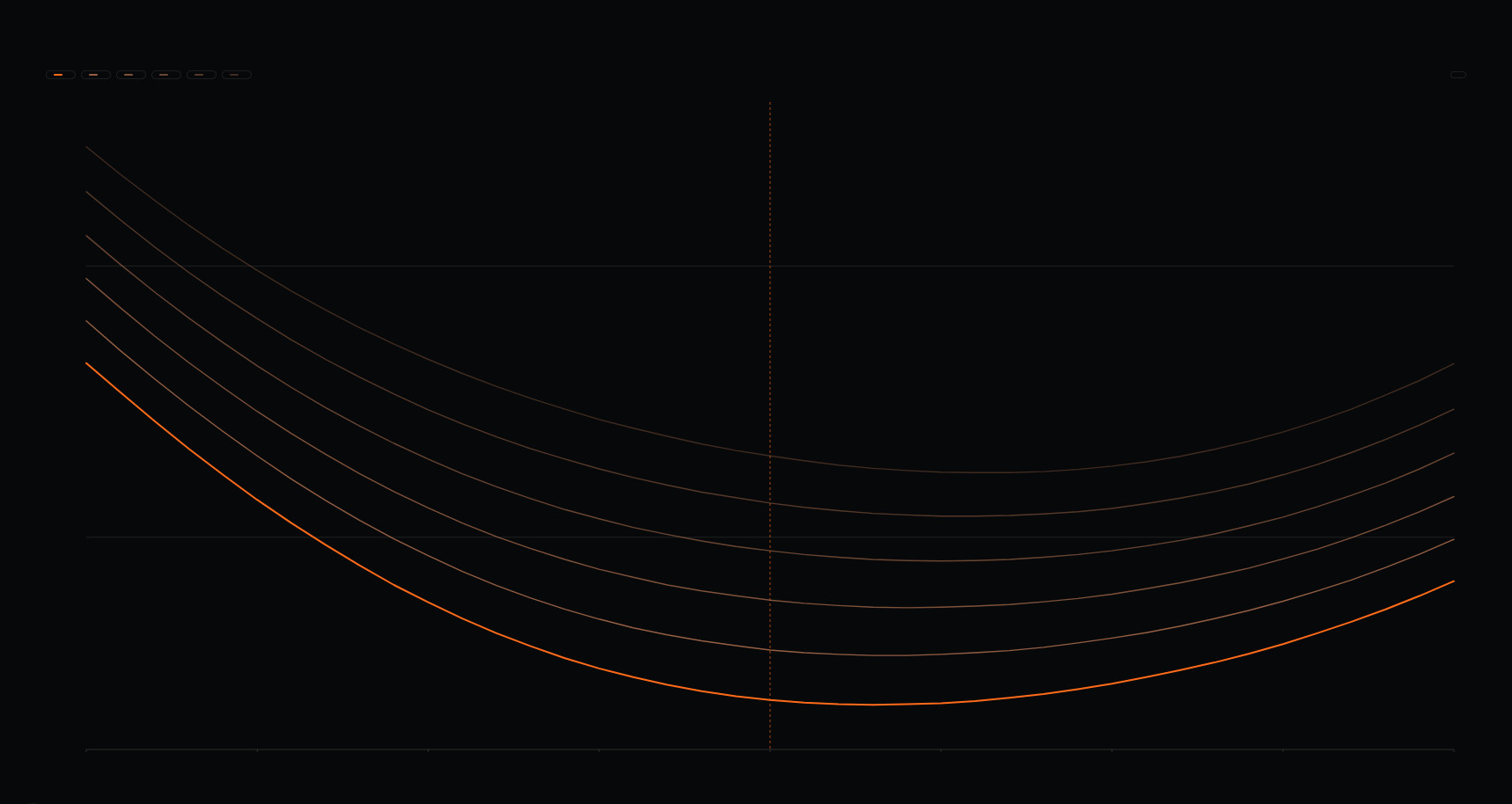
Before a scheduled event, traders often look at the price of an at-the-money straddle to gauge the movement options are charging for. A straddle combines a call and a put at the same strike and expiry. Its price is a useful market quote. Calling it the expected move is convenient shorthand, but the straddle price is not a guaranteed range or a direct statistical confidence interval.
Read the quote in its own units
Suppose a stock trades near 200 and an at-the-money straddle spanning an announcement costs 12. The option market is charging 12 per share, or about six percent of spot, for the combined call and put. A large move in either direction helps a long straddle; time passing and a drop in implied volatility can hurt it. The breakeven prices at expiry also depend on the premium paid and the strike.
The same 12-dollar straddle can have a different meaning if it expires tomorrow rather than next month. A longer expiry contains more ordinary trading days in addition to the event. Choose the contract that actually spans the announcement and name its expiry when quoting the figure.
What event premium does
Uncertainty about earnings, a central-bank decision, or another scheduled release can lift implied volatility in options that cover the event. Once the information arrives, the premium for that specific unknown may fall. A call buyer can correctly anticipate the direction and still lose if the underlying move is smaller than the option premium and the volatility decline are worth.
That is why the underlying move should be compared with the cost of the option strategy, not just with the trader's directional conviction. An event can also change a GEX profile. A pre-event picture may be a poor map for the post-event market.
Compare like events, carefully
Looking at prior announcements can provide context, but a small sample of eight earnings releases is not a stable law. Note whether the business, market environment, and option pricing changed. Compare the implied move before each event with the move over the same event window after it. Keep misses and outliers in the sample instead of choosing only the memorable releases.
The straddle also says nothing about direction. If a trader expects an upside surprise, the separate question is whether the chosen call or spread offers attractive terms for that view after premium, decay, and possible volatility compression.
After the announcement
Recheck the option market and the underlying after an announcement. Expiries that carried event premium may reprice sharply. Old walls and flips can move, so yesterday's chart may no longer describe the market in front of you.
Sources and further reading
The research this guide leans on. Citations rather than links, so they stay verifiable after journal URLs move.
- Patell, J.M. and Wolfson, M.A. (1979). Anticipated information releases reflected in call option prices. Journal of Accounting and Economics 1(2).
- Dubinsky, A., Johannes, M., Kaeck, A. and Seeger, N.J. (2019). Option Pricing of Earnings Announcement Risks. Review of Financial Studies 32(2).
- Carr, P. and Wu, L. (2009). Variance Risk Premiums. Review of Financial Studies 22(3).